
Seeing Ourselves from Space: Why The Artemis Images Are More Important Than You Think
Part One: On Believing What We See
On April 1, 2026, at 6:35 in the evening, four people strapped themselves to a 322-foot rocket at Kennedy Space Center and left the planet. Reid Wiseman. Victor Glover. Christina Koch. Jeremy Hansen. The Space Launch System lit 8.8 million pounds of thrust beneath them, and within minutes Orion was climbing toward a place no human had visited in more than fifty years.
Five days later, on April 6, they swung around the far side of the Moon in a seven-hour pass, lost contact with Earth for forty minutes as the Moon's bulk put them behind a radio shadow, and came back into signal carrying thousands of photographs. NASA released the first of them on April 7. I have been studying them over the last several days, not just as a reader of headlines and space enthusiast, but as a photographer.
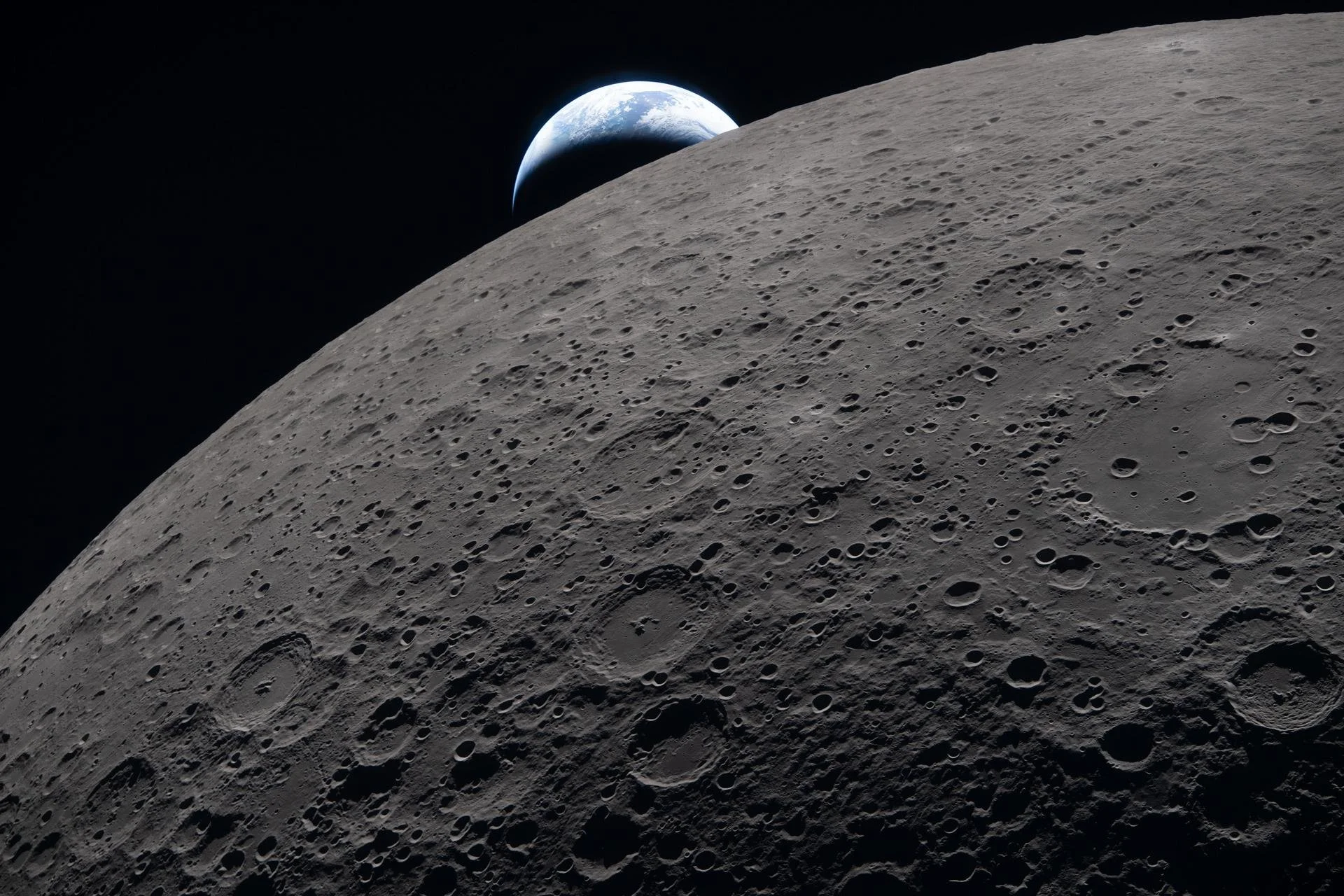
[The lunar surface fills the frame in sharp detail, as seen during the Artemis II lunar flyby, while a distant Earth sets in the background. This image was captured at 6:41 p.m. EDT, on April 6, 2026, just three minutes before the Orion spacecraft and its crew went behind the Moon and lost contact with Earth for 40 minutes before emerging on the other side. In this image, the dark portion of Earth is experiencing nighttime, while on its day side, swirling clouds are visible over the Australia and Oceania region. In the foreground, Ohm crater shows terraced edges and a relatively flat floor marked by central peaks — formed when the surface rebounded upward during the impact that created the crater. Image Credit: NASA]
I want to tell you what I see when I look at this photograph, and why seeing it well matters right now.
The frame is mostly the lunar surface, close and grey and impossibly detailed, with as surface full . In the far distance, a thin blue crescent rests on the Moon's limb. That is the Earth. Australia and Oceania hold the daylight edge. The rest of the planet is dark. It is a beautiful throwback to the famous Earthrise image, but more on that later.
Within hours of the release, a familiar chorus arrived online:
The images are AI-generated.
The mission was staged.
Apollo was staged, Artemis is staged, the whole enterprise a continuation of a 1969 hoax with better software.
I understand why people want to say this. I even understand the fear underneath it. But I want to invite anyone who has wondered, quietly or loudly, whether any of this can be trusted to stand beside me at the frame for a minute and look at what is actually there.
I teach photography for a living. I help run a darkroom, teach post-processing and retouching, do commercial product work and lighting. I spend my days studying the physics of light as it falls on silver and silicon. When I look at the Artemis images I do not see fabrication. I see the things a photograph carries when it is made by a real camera pointed at a real world. I see evidence of truth over falsehood:
Look at the reflections. In the cabin images of Koch and Glover, the Orion window frames catch interior light and throw it back onto the astronauts' faces in the exact way a curved, double-paned porthole would. The catchlights in their eyes are doubled, because there are two layers of glass between them and the sun. Generative image models do not solve layered reflections. They hallucinate them.
Look at the noise. A real sensor, pushed to high ISO in deep space, produces a particular grain: chrominance noise in the shadows, slight color banding across smooth gradients, a faint spatial pattern from read noise in the sensor's amplifier chain. The Artemis frames carry that signature. A model trained on cleaned internet images does not reproduce sensor noise truthfully. It produces a smoothness in the shadows that a real camera at high gain never achieves.
Look at the atmospheric details in the Earth frames. You can see the sodium layer, a thin glowing band roughly 90 kilometers up where meteoritic sodium atoms fluoresce in sunlight. You can see auroras at the poles, faint green and red curtains shifting with the solar wind. You can see the airglow of the upper atmosphere, a soft ring against the dark limb. These are not things a visual effects team remembers to put in. They are things that get photographed because they are there.
Look at the lens flares. A wide-angle lens pointed near the sun throws a specific chain of ghost reflections across the frame, determined by the exact geometry of the elements inside the barrel. The flares in the eclipse frame fall where they should fall for the known optics of the Orion cameras. You can trace the ghosts back to the primary light source and check the spacing. The math works.
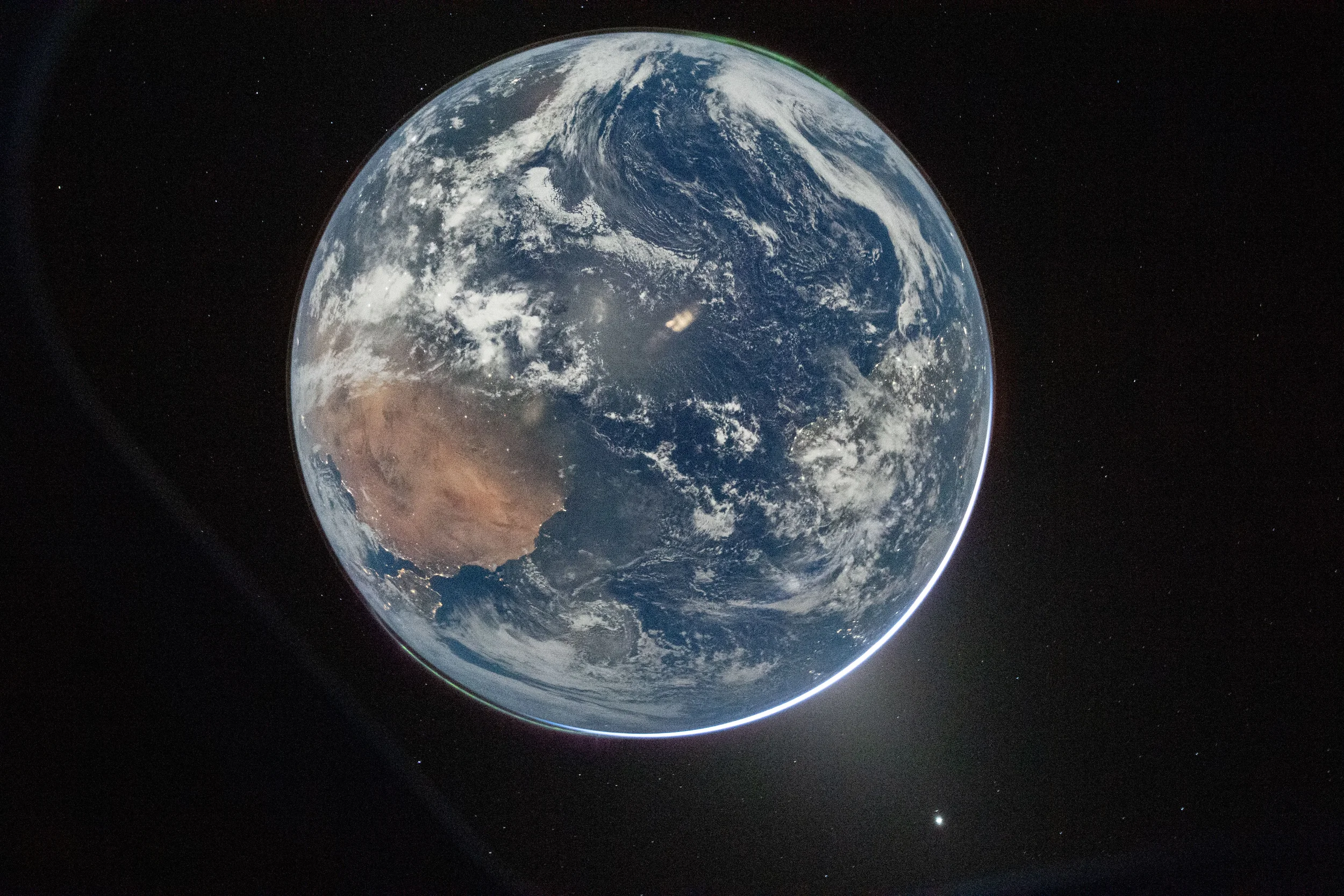
[NASA astronaut and Artemis II Commander Reid Wiseman took this picture of Earth from the Orion spacecraft's window on April 2, 2026, after completing the translunar injection burn. Image Credit: NASA/Reid Wiseman]
This is not a small point. NASA took the photographic weight of this mission so seriously that they sent the crew to the Rochester Institute of Technology for training under working photographers. RIT alumni spent time teaching Wiseman, Glover, Koch, and Hansen how to read light, frame an image, and make technical decisions under pressure, because NASA understood that the pictures would matter as much as any instrument reading (you can find information here: https://www.rit.edu/news/rit-alumni-train-artemis-ii-astronauts-photography). The crew practiced. They learned how their cameras would behave in vacuum, in hard sun, in the dim cabin light. When I look at these images I see the work of people who were trained to see.
The old Apollo complaints keep getting recycled, and none of them hold up any better than they did the first time. The claim that lunar shadows should be parallel forgets that the Moon has no atmosphere to scatter light, that the surface is uneven, and that wide-angle lenses bend straight lines by design. The claim that a flag waved on Apollo footage mistakes inertia for wind; in a vacuum, a flag keeps moving longer, not shorter. The claim that stars are missing misunderstands exposure; a camera set for bright sunlit rock will always black out anything as dim as a star. The claim about the Van Allen belts ignores both the trajectory planning and the dosimetry data. The claim that the rocks are fabricated ignores half a century of independent petrologic study in labs around the world. And the list goes on and on and misses the entire point.
And yet the doubt continues. There is also a problem with scale and numbers the denial never quite sits well with. Apollo drew on roughly 400,000 workers across more than 20,000 companies and universities. Artemis draws on a comparable transnational web. The Deep Space Network alone runs three complexes, at Goldstone in California, Madrid in Spain, and Canberra in Australia, each one staffed around the clock, each one capable of independently tracking Orion's signal and decoding its telemetry. Amateur astronomers are following the spacecraft from their backyards. Ham radio operators pinged it. The lie, if it were a lie, would have to be larger than the truth it was trying to replace.
I do not say this to win an argument. I say it because I believe people are lonely in their suspicion, and I think the suspicion is costing them something real and it saddens me.
The instinct to doubt is reasonable. People have been manipulated, often, by advertisers and algorithms and institutions that have at times genuinely lied and continue to prey on individuals as product and means to a commercial end. Doubt is the beginning of thinking. The trouble starts when doubt has no counterweight, when it hardens into a posture that insists the only reliable witness in the room is the self, alone.
I feel, therefore it is.
I was not fooled, therefore I am the only one still thinking.
Michael Polanyi called the quiet foundation under all knowing tacit knowledge, the scaffolding of trust in other people whose work we cannot personally redo. You did not verify the chemistry of the medicine you took this morning. You did not survey the bridge you drove over. To live as a person in a world is to accept, every hour of every day, that reality is larger than what you can measure yourself. I think most of us would rather be wrong and feel in control than be correct and have to face how much we do not, and cannot, know. That is the engine of this. Not malice. Something closer to fear.
I think much of my feelings on this can be crystalized from a moment in the flyby that I feel is imperative. During the seven hours the crew spent on the far side of the Moon, Jeremy Hansen asked Mission Control for permission to name a lunar crater. He wanted to name it for Carroll Wiseman, Reid's late wife. Carroll had died before she could see her husband fly. Hansen asked. Mission Control agreed. In lunar orbit, four astronauts paused the work of the mission to name a piece of the Moon for a woman who had loved the man now looking out the window.
Reid later said it was the pinnacle moment of the mission. He said the four of them were in tears on the far side of the Moon. He said that was where they were the most forged, the most bonded. A crater on another world now carries the name of a woman from Earth who did not live to see it.
I want to sit with that for a minute. Whatever else a people think is going on with these images, this is the thing I cannot get past. Four human beings rode a controlled explosion off the planet, carried their grief with them into lunar orbit, and stopped in the middle of a mission that had consumed years of their lives to name a crater for someone they loved. That is not a soundstage. That is not a visual effects team. That is people. Tens of thousands of engineers and machinists and flight surgeons and software developers built the rocket that carried that grief. The people who calculated the trajectory, and the people who wrote the code that kept them alive, and the people who listened from Goldstone and Madrid and Canberra as they came back around the near side, are all also people.
To wave that away from a sofa, to say it never happened, is to miss something I would grieve for you to miss. These photographs are a gift. They were made by people who went, and looked, and came home. I would rather trust them and be wrong than refuse them and be alone.
Part two: seeing Together
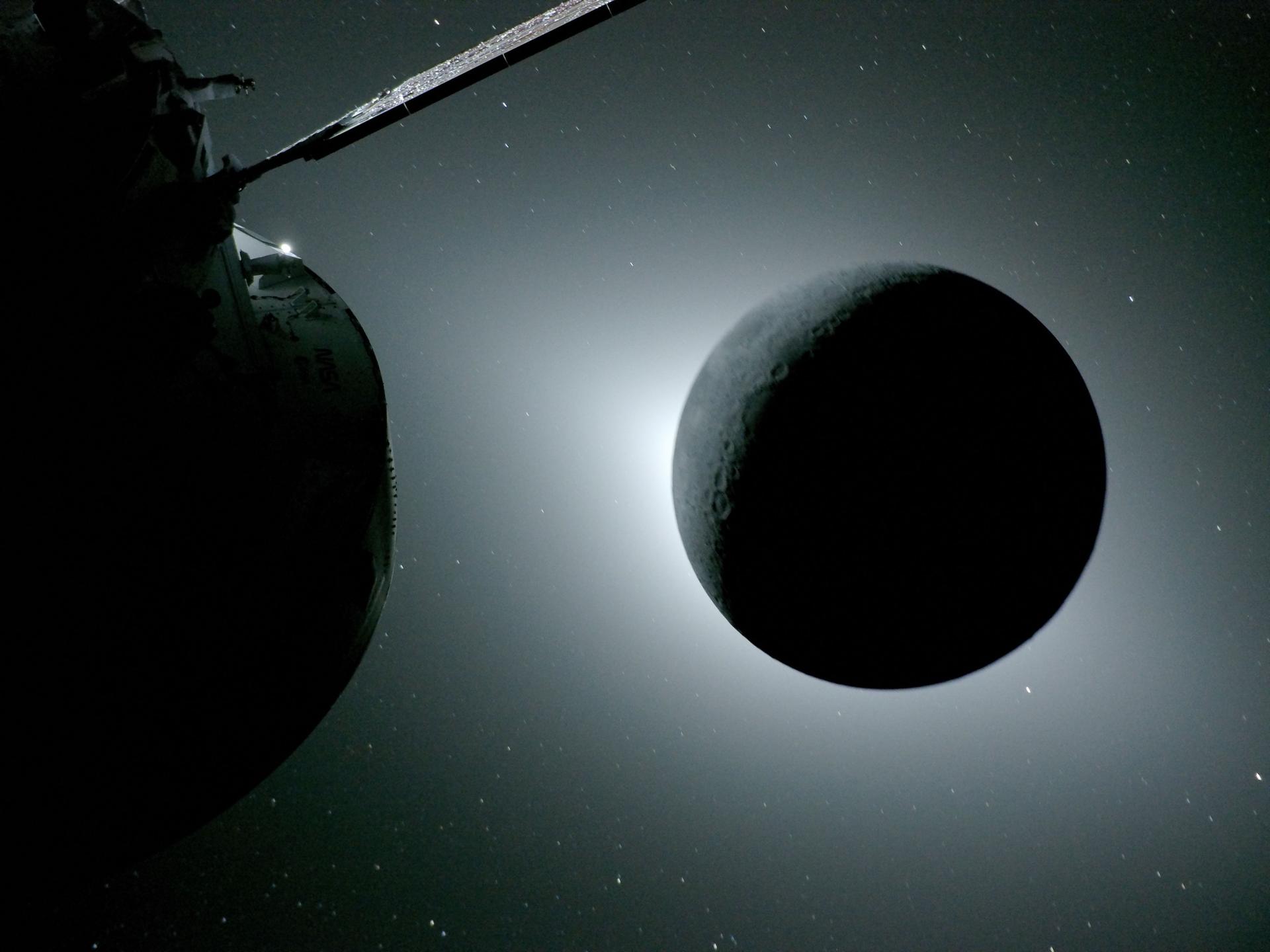
[The Moon, seen here backlit by the Sun during a solar eclipse on April 6, 2026, is photographed by one of the cameras on the Orion spacecraft’s solar array wings. Orion is visible in the foreground on the left. Earth is reflecting sunlight at the left edge of the Moon, which is slightly brighter than the rest of the disk. The bright spot visible just below the Moon’s bottom right edge is Saturn. Beyond that, the bright spot at the right edge of the image is Mars. Credit: NASA]
On Christmas Eve in 1968, William Anders leaned across the command module of Apollo 8 and photographed a blue and white Earth rising over the grey lip of the Moon. He almost did not take the picture. The crew had not planned for it; Earthrise was not on the mission checklist. But when the Earth slid into view over the lunar horizon, Anders asked Frank Borman for a roll of color film, and the shutter clicked, and the world we all live in changed a little.
The photograph that came back did work no sermon or editorial in the prior decade had managed. It gave the environmental movement its first common picture of the planet as one fragile thing. It seeded the Whole Earth Catalog. It rearranged how a generation thought about borders and weather and belonging. Frank White later put a name to the cognitive shift astronauts kept describing after seeing Earth from orbit. He called it the overview effect, the involuntary dissolution of the lines that had seemed, from ground level, like the most important things in the world.
The Artemis images are not a nostalgia trip back to Earthrise. They are something stranger. This time the Moon is the foreground and Earth is the small blue crescent slipping behind its edge. We are the visitor in the frame. We are the thing being looked at. If Earthrise taught us that we all live on one planet, these new photographs ask a quieter question: do we still know how to see it together?
Wendell Berry spent his life writing about how a place becomes home only when people tend it alongside other people over time. He called that slow accumulation of belonging membership. A planet is also a place. A photograph of Earth setting over Ohm crater is an invitation to a membership most of us have never consciously claimed. You live on that blue crescent. So does everyone you have ever loved and everyone you have ever fought with. It is the only one there is.
Wonder is not a private hobby. It is something closer to a civic practice, one of the last ones we have left. We no longer share a television schedule or a front page or a common song. We barely share a vocabulary. An image like this can still stop two strangers in a coffee shop long enough for one of them to say, did you see it. A country is built out of small bridges, and that sentence is a bridge.
I think a young boy has helped to solidify this wonder for us in recent days. Hilt is eleven years old. He lives in Little Rock, Arkansas. From what I can tell, he loves rockets, really loves them, the way some kids love baseball or dinosaurs. For spring break, his parents took him to Cape Canaveral to watch Artemis II lift off. He wore an Artemis trajectory shirt. He stood in the crowd when the boosters ignited, and he said later that about twenty seconds after ignition the ground started shaking, and it was so loud, and it was so amazing, and when the rocket finally cleared the tower he started crying tears of joy. A CNN reporter pushed a microphone toward him and why he wanted to be at the launch and part of history, and Hilt, without a drop of irony, without a single cool-kid defense against the moment, said they were going to the freaking moon. (To be fair, he did not quite say freaking, but I’ll make an editorial translation.)
The clip went viral within hours. By the next morning the White House had quoted him. By the end of the week he had been on the news, met astronauts at the Kennedy Space Center Visitor Complex, and told anyone who would listen that he wants to be an astronaut or own his own aerospace company someday. I have watched the clip several times. Not because the language is funny, but because Hilt is standing in the exact posture the rest of us have mostly forgotten how to hold. He’s eleven. He has not yet learned to be embarrassed by awe and wonder. He has not yet learned to pre-arm his face against surprise. When a rocket carrying four humans leaves the atmosphere in front of him, he cries about it and says what he actually feels. That is not a child being naive. That is a human being accurate. The accurate response to a vehicle lifting a crew to the Moon is tears.
The buffered adult self, the one I was trying to describe in the above, cannot cry at a rocket. It has too much to protect. It has to make sure no one sees it being moved by something it did not choose to be moved by. A child has not yet built that wall. Most of us built the wall for good reasons. We were embarrassed once, or hurt, or laughed at, and the wall has kept some things out that needed to stay out. But the wall keeps other things out too. It keeps rockets out. It keeps crescent Earths out. It keeps the company of strangers who would have loved the same photograph with you.
I do not think the way back to each other runs through an argument. I think it runs through a moment of shared looking. Hilt Boling standing at a fence in Florida is doing the same thing William Anders did in 1968 and the same thing Christina Koch is doing right now at her window. He is letting the world be bigger than his ability to contain it, and he is bearing witness to that in front of other people. That is what public wonder looks like. It is not cool. It is not sophisticated. It is true.
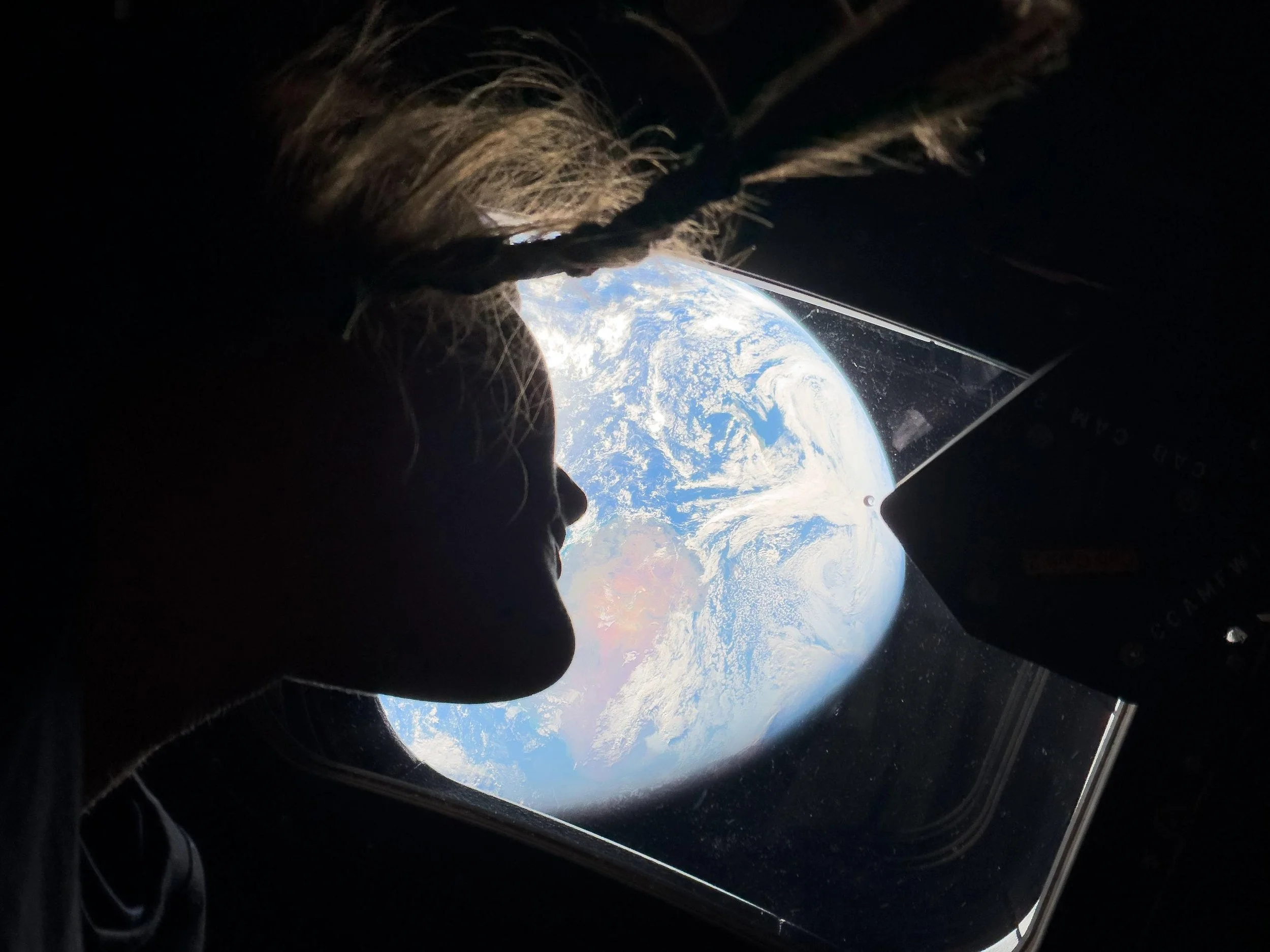
[NASA astronaut and Artemis II mission specialist Christina Koch peers out of one of the Orion spacecraft's main cabin windows, looking back at Earth, as the crew travels towards the Moon. Image Credit: NASA]

Dreaming a future together has to begin with seeing the same thing together, and the last fifty years have given us fewer and fewer things to see in common. Artemis II offers one. A photograph of Earth setting over the rim of the Moon is a small bridge between strangers. So is an eleven-year-old who could not hold the joy in. Take the bridge. Let the photograph gather you. If you need a place to start, stand next to Hilt for a second and say, out loud, what he said. “We are going to the freaking moon!” You do not have to say freaking (my wife would not appreciate that language). But in my opinion, you should say the rest of it, and you should mean it. We are going to the moon. Together.
Part Three: SEEING OURSELVES AS SMALL
The hardest thing these photographs ask of us is not belief. It is smallness.
Our instinct is to flinch at that word. We read smallness as diminishment, as an insult to the self we have spent our lives assembling. The tradition I am writing out of has always known something different: that smallness, rightly scaled, is the beginning of seeing anything at all. You cannot be astonished by a thing you have already fit inside your own head.
C.S. Lewis wrote a short essay called "Meditation in a Toolshed" about standing in a dark shed with a shaft of sunlight coming through a crack above the door. You can look at the beam from the side and see a bright bar of dust in the dark. Or you can step into the beam itself and look along it, up through the crack, out of the shed, past the leaves of the tree outside, across the ninety-three million miles of space that separate you from the sun. Both views are real. Modernity has trained us to believe that looking at the beam from outside is the only honest posture, the only one a grown person takes. The Artemis photographs ask for the other kind of looking. They ask you to step inside the beam.
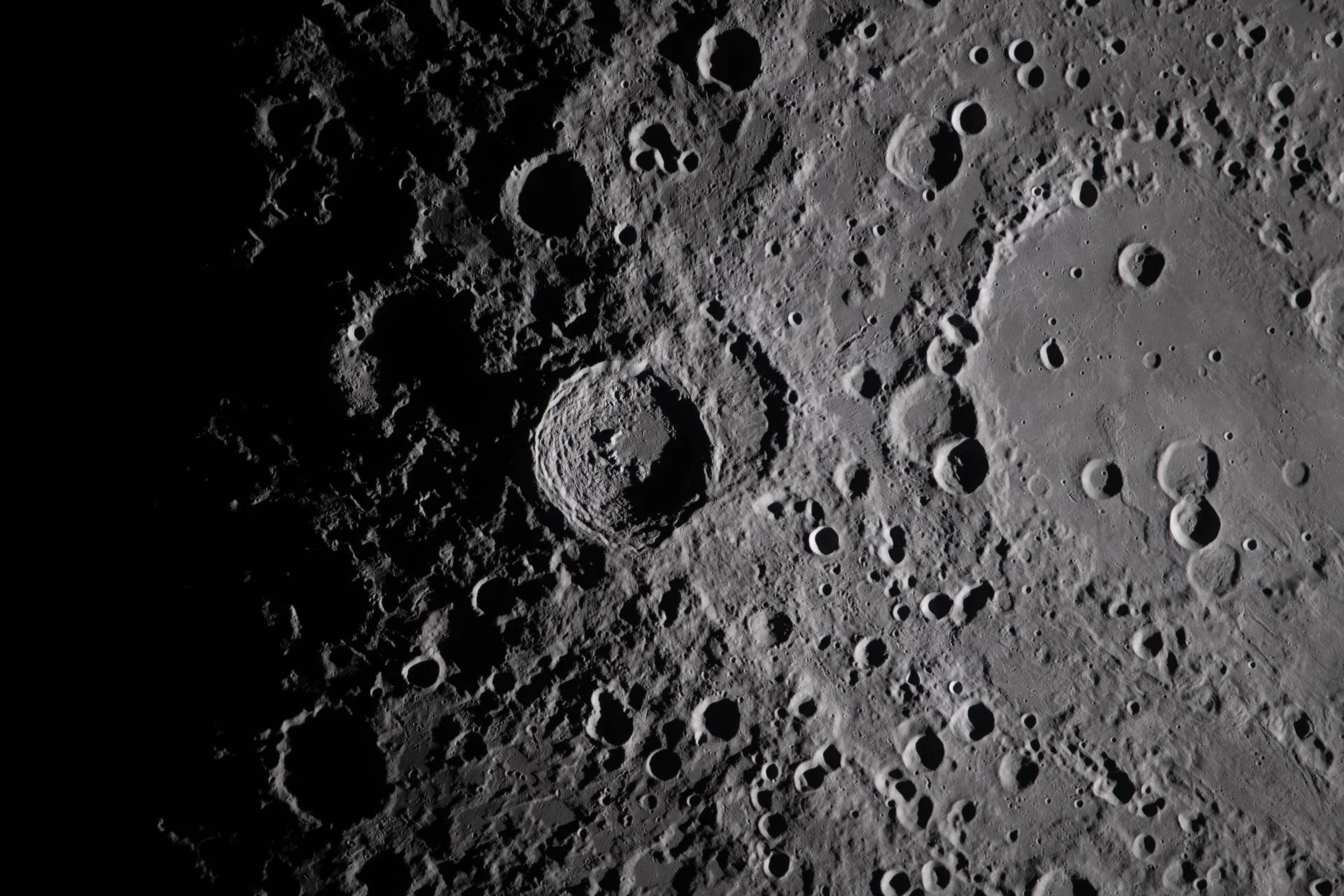
{A close-up view taken by the Artemis II crew of Vavilov Crater on the rim of the older and larger Hertzsprung basin. The right portion of the image shows the transition from smooth material within an inner ring of mountains to more rugged terrain around the rim. Vavilov and other craters and their ejecta are accentuated by long shadows at the terminator, the boundary between lunar day and night. The image was captured with a handheld camera at a focal length of 400 mm, as the crew flew around the far side of the Moon. Image Credit: NASA]
Psalm 8, one of my favorite poems as a Christian is a psalm written by someone doing exactly that:
”When I consider your heavens, the work of your fingers, the moon and the stars which you have set in place, what is man that you are mindful of him.”
The psalmist is not being humiliated. He is being proportioned. He is standing where the world is larger than he is and letting that largeness tell him the truth about himself. The truth turns out to be more, not less: he is a small thing held in mind by something vast.
You do not have to share the theology to feel the pull of the claim. Abraham Joshua Heschel, writing out of the Jewish tradition, called this “radical amazement” and argued that it is the beginning of knowledge, not the enemy of it. William Blake, further afield and arguably stranger, believed that “if the doors of perception were cleansed, everything would appear to us as it is, infinite.” He thought you could see a world in a grain of sand and a heaven in a wild flower, hold infinity in the palm of your hand, and eternity in an hour. All three of these writers were trying to understand a similar experience, but attributing it to different things.
I have stood at that door before, and I have tried, with mixed success, to photograph what I saw on the other side of it.
Years ago I wrote a Master's thesis in which I tried to name a quieter kind of wonder than the one Burke and Kant had described. The old sublime was loud. It came from thunderstorms and mountaintops and shipwrecks, and the romantic ego of a man made bigger by his survival of them. It elevated the human over nature through sheer agency of experience. The sublime I was after was smaller and more patient. I called it the contemplarary sublime (not contemporary, contemplarary… it’s artsy, okay?): a sublime that arrives in whispers instead of thunder, in small rooms and slow reflections, in a sheet of gold mylar rustling in the breath of a fan. I built three light-based sculptures and called them, together, Ad Infinitum. They were attempts at spaces where a person could briefly stop trying to contain the world and let the world be larger than the container. That is what I think the sublime really is. Not a trick of scale. The moment someone stops trying to master a thing and lets it be what it is.
I tell you this not to applaud my own work but because I think the Artemis photographs are doing the same thing I was trying to do, even if no one on the crew intended them that way. They are records of people who put down the need to make the universe smaller than themselves, picked up a camera, and pressed the shutter at the moment the thing in front of them refused to fit.
A photograph of Hertzsprung Basin on the far side of the Moon, a two-ringed impact structure no human eye had seen directly until last week, is worthless to a person who will not be made small by it. But to a person who will, it is an opening. It is a door held ajar. It is an invitation to be proportioned rightly, for a minute, against a very old piece of a very large universe.
Robert Frost has a line carved on his tombstone, pulled from the end of one of his poems: “I had a lover's quarrel with the world”. I have always loved that sentence because it refuses two easier postures at once. A lover's quarrel is not contempt and it is not surrender. It is the fight you have with something you mean to keep loving. I worry that many of the people refusing these photographs are not quarreling with the world anymore. They have divorced it. They have decided the world is so untrustworthy that the only safe ground left is the ground inside their own head. I want to say, as gently as I know how, that this is a lonely place to live, and that nothing true grows there. A lover's quarrel is better than a divorce. A lover's quarrel leaves the door open.
Paul wrote to the Galatians that each of them should make a careful exploration of who they are and the work they have been given, and then sink themselves into that work, and not be impressed with themselves, and not compare themselves with others. I think about that instruction when I look at the Artemis crew. They are going on behalf of others and assuming incredible risk to do so. That is the posture the rest of us are being invited to learn. Not humiliation. Not self-erasure. Just the quiet willingness to be smaller than the thing you are looking at, and to let the looking do its work.
The way back, at the end of all this, is not an argument. It is a photograph. Look at the Earthset frame one more time. The grey crater in the foreground. The terraced walls of Ohm. The central peaks that splashed upward in a single moment of impact and froze there mid-motion. The thin blue crescent in the distance, with Australia lit and the rest of the planet dark. Three minutes after that shutter clicked, Orion slipped behind the Moon and the crew lost signal for forty minutes. Somewhere in those forty minutes, Jeremy Hansen asked for permission to name a crater for a woman named Carroll. Then they came back around the limb, and the signal found them again, and they sent us pictures.
What you do with that is up to you. I know what I am going to do. I am going to keep looking. I am going to let the looking make me smaller. I am going to thank the people who made it possible. And I am going to try, in whatever small ways are available to me today, to stand in the posture that an eleven-year-old in an Artemis shirt stood last week and say, without apology, what is actually true.
Onward!
If you want the science side of this told with the energy it deserves, Hank Green made a very good video about the mission that is worth your time: https://youtu.be/oaXRREHVkHo. Watch it. Then come back to the photographs. Let it be what it is.